
Daoist Academy
The Daoist Academy: Live the Tao for One Week
Quarterly Retreat | Nianbadu, Quzhou, Zhejiang | Dongyue Temple (Ming Dynasty, Wanli Era) | Tao · Talisman · Yangsheng
1. Introduction
Daoism is not a dusty ancient book. It is a living tradition – something you feel with your body, practice with your hands, and experience with your heart.
We believe that true Daoist wisdom cannot be transmitted through screens alone. Sometimes, you need to stand on the stone steps of a Ming Dynasty temple, breathe the mountain air, hear the morning bell, and draw your first talisman under the guidance of a master.
That is why we created the Daoist Academy.
Once every three months, we invite a small group of sincere seekers to Dongyue Temple in Nianbadu, Quzhou, Zhejiang – a temple first built during the Wanli era of the Ming Dynasty (1574) – to spend seven days with us. During this week, you will step away from daily noise and immerse yourself in three core areas of Daoism: Tao (philosophy & scriptures), Fu Talismans (calligraphy & energy writing), and Yangsheng (Qigong, meditation, and traditional Chinese health wisdom).
This is not a tour. This is a retreat. A homecoming.
“The Tao cannot be told, but it can be lived.” — Ancient Daoist saying
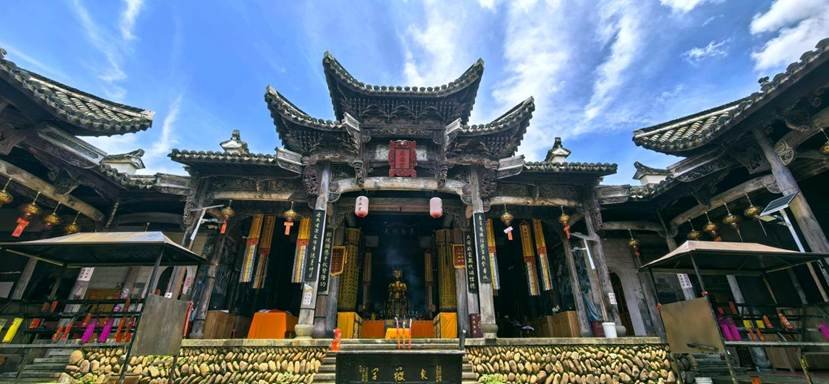
2. Our Temple: Dongyue Temple
Location: Nianbadu Ancient Town, Quzhou, Zhejiang, China
Founded: Wanli era, Ming Dynasty (1574)
Significance: One of the most important Daoist temples in the Nianbadu region, with over 400 years of continuous incense offering.
Nianbadu is a thousand‑year‑old town hidden at the triple border of Zhejiang, Fujian, and Jiangxi provinces. Unlike the bustling water towns of Suzhou, Nianbadu is quiet, unpretentious, and remarkably slow‑paced. Dongyue Temple sits within this landscape – grey tiles, surrounded by ancient trees.
The temple is modest in size but exceptionally pure in atmosphere. The main hall is dedicated to Dongyue Dadi (The Great Emperor of Mount Tai), who governs life, death, and rebirth. Side halls are used for teaching, meditation, and talisman drawing. Behind the temple, there is a small vegetable garden and a few simple guest rooms – your home for the week.
There is no hotel luxury. Only authentic monastic life: early to bed, early to rise, simple vegetarian meals, and silence shared with the mountains.
When you stand on the threshold of Dongyue Temple, you walk the same stones that Daoist practitioners have walked for four centuries. Every breath you take is infused with the temple’s incense and the mountain’s clarity. That is the weight of lineage.
3. Program: 7 Days, Three Modules
The curriculum varies slightly each season, but the structure remains consistent. Below is a sample 7‑day schedule:
Day 1 – Arrival & Opening
Afternoon: Arrive in Nianbadu, check in at the temple guest quarters
Evening: Opening ceremony, welcome speech by the head priest, introduction to the temple’s history and the week’s schedule
Night: First meditation session – letting go of distractions
Day 2–3 – Module One: Tao (Philosophy)
Introduction to Daoist thought: Dao, De, Wu Wei, Ziran
Guided reading: selected chapters from the Tao Te Ching and Hua Hu Jing
Daoist cosmology: Yin‑Yang, Five Elements, Bagua basics
Discussion: how to apply Daoist wisdom to modern life and emotional management
Daily morning & evening chanting with the resident priest
Day 4–5 – Module Two: Fu Talismans
History and principles of Fu talismans: what is a Fu? What is a Lu?
Tools of the craft: cinnabar, yellow paper, brushes – their symbolism and preparation
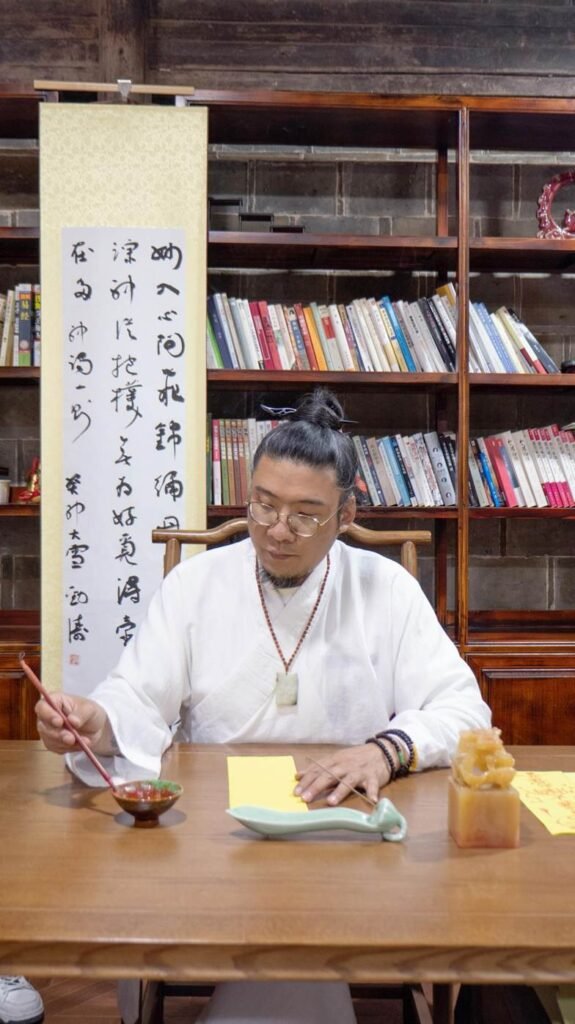
Basic talisman strokes: from tracing to creating simple talismans (peace, clarity, protection)
The energy behind each stroke: how a talisman works as a spiritual technology
Practice: each participant draws a small talisman under the master’s guidance
Discussion: talismans and their relationship to intention, focus, and psychology (suitable for Western understanding)
Day 6 – Module Three: Yangsheng (Nourishing Life)
Daoist health philosophy: living in harmony with the seasons
Morning practice: Ba Duan Jin (Eight Brocades) or Taiji basics
Breathing methods: Daoist “Tuna” (exhaling the old, inhaling the new)
Food wisdom: seasonal eating according to the Five Seasons
Advanced meditation: from counting breaths to “emptying the heart”
Afternoon: Introduction to medicinal herbs – common wild herbs for health
Day 7 – Closing & Departure
Morning: Review, Q&A, sharing of experiences
Short closing ceremony: blessing words from the priest, each participant receives a consecrated talisman drawn by the priest
After lunch: farewell to Dongyue Temple, departure
Note: Each day begins with morning chanting and meditation, and ends with optional evening sitting or tea conversation. The entire week is vegetarian.
4. Who Is This For?
The Daoist Academy is not only for “believers.” It is for anyone who is open, sincere, and willing to temporarily put down their phone and calendar.
You might be a good fit if:
You are curious about Daoist philosophy but don’t know where to start
You practice yoga, meditation, or Qigong and want to explore their Eastern roots
You work in healing, arts, or spirituality and seek deeper cultural grounding
You feel exhausted, lost, or disconnected from nature and need a quiet space to recalibrate
You simply want to spend a week in a real ancient Daoist temple and experience monastic life
No prior Daoist knowledge is required. Only an open heart.
5. Teaching Team
All courses are taught by the resident priests of Dongyue Temple and their disciples. They are not academics – they are practitioners who have lived in the temple for decades.
Head Priest: Over 20 years of practice at Dongyue Temple, expert in talismans and rituals
Talisman Instructor: Formally trained in the orthodox lineage, skilled at teaching complex talismanic principles to beginners
Yangsheng Instructor: Trained in both traditional Chinese medicine and Daoist health practices
They may not speak fluent English, but we provide professional interpreters (Chinese to English) to ensure smooth communication.
6. Practical Information
Dates: Once per quarter, 7 days each
2026 Sample Schedule:
Spring: April 6–12
Summer: July 6–12
Autumn: October 5–11
Winter: January 4–10, 2027
Group size: Maximum 20 participants per retreat
Price: $12,888 USD per person
Includes: 7 days of accommodation & meals, all courses, materials, talisman drawing supplies, a consecrated talisman upon departure, translation services, and one Haiqing (traditional Daoist robe).
Does not include: transportation to/from Nianbadu.
Registration Process:
1.Pay the full fee ($12,888) via the link below.
2.Within 24 hours of successful payment, we will email you a detailed information form.
3.Fill in the form with your personal details (full name, age, nationality, emergency contact), flight information (so we can arrange pickup), and Haiqing size (we will prepare a custom‑fit traditional Daoist robe for you).
4.After receiving your form, we will send a confirmation email and a detailed arrival guide one week before the retreat.
Cancellation Policy:
Cancellation 30+ days before start: full refund
Cancellation 15–30 days before start: 50% refund
Cancellation within 15 days: no refund, but you may transfer your spot to another person
7. FAQ
Q: I don’t speak Chinese. Can I still attend?
A: Yes. We provide on‑site Chinese‑English interpretation. Some materials are available in English.
Q: Do I need to be a Daoist to join?
A: Not at all. People of any religion or no religion are welcome. Only genuine interest is required.
Q: What is a Haiqing?
A: Haiqing is the traditional daily robe worn by Daoist practitioners – loose‑fitting, long‑sleeved, usually dark blue or black. After registration, we will prepare one for you based on the size you provide. During your week at the temple, you may wear it for classes and ceremonies, fully experiencing the monastic way of life.
Q: Can I stay in touch after the week ends?
A: Yes. We maintain an alumni community, and the priest offers occasional online Q&A sessions. You may also re‑register for future retreats (returning participants receive a discount).
Q: Is the area safe?
A: Nianbadu is a very safe, peaceful ancient town with friendly locals. The temple is inside the town, surrounded by shops and inns. Our staff will accompany you throughout.
Q: Can I take photos or videos?
A: Photos are allowed in public areas (courtyard, classroom). Please do not take photos in front of deity statues, during rituals, or without others’ consent. Some parts of talisman drawing may not be filmed – we will inform you beforehand.
Q: What is the cancellation policy?
A: Please refer to the “Cancellation Policy” in the Practical Information section above.
8. Closing Words
Countless seekers have walked the stone steps of Dongyue Temple. Some found answers here. Some found peace. Some found nothing – they simply stayed for seven quiet days, only to realize upon leaving that they were no longer quite the same.
The Tao is not far from us. It is in the mountain wind, in the morning bell, in the single moment of focus when you lift your brush to draw a talisman.
We invite you to come stay for a week.
