
About us
Dongyue Temple: Over 400 Years of Daoist Heritage
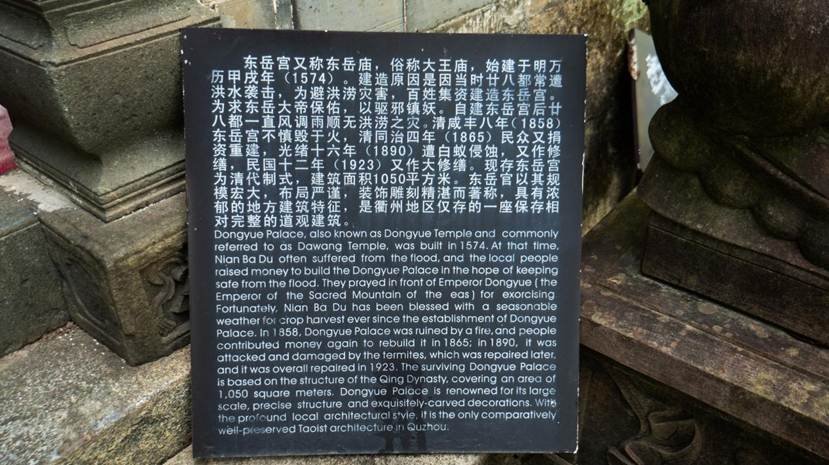
Behind Nature and Tao stands a living, ancient Daoist temple with an unbroken lineage of over four centuries — Dongyue Temple (Dongyue Gong) in Nianbadu, Jiangshan, Zhejiang.
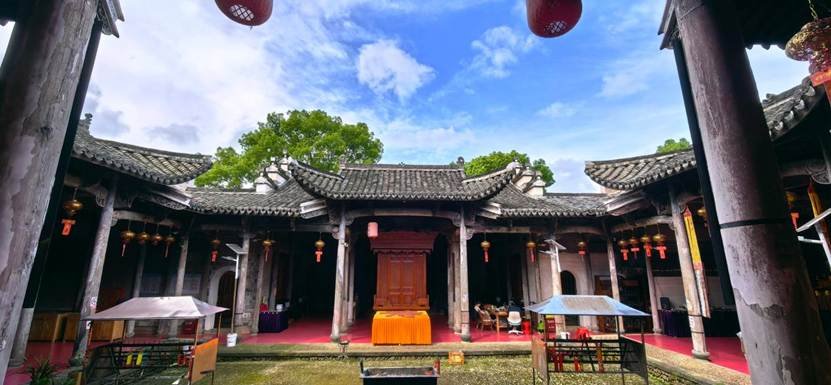
Dongyue Temple, also known as Dongyue Miao or commonly as Dawang Miao (Great King Temple), was first built in the first year of the Wanli era of the Ming Dynasty (1574 AD). It sits at the southeastern corner of the ancient town of Nianbadu, where the three provinces of Zhejiang, Fujian, and Jiangxi meet. Laid out along a strict central axis and built according to traditional Daoist architectural norms, it is a provincial-level cultural heritage site protected by Zhejiang Province. The temple underwent multiple renovations during the Ming and Qing dynasties. During the Tongzhi era (1862–1874) of the Qing Dynasty, the abbot Hou Linian raised funds to restore the temple, which then comprised three halls in succession: the Hall of the Spiritual Officer at the front, the Hall of the Patriarchs in the middle, and the Hall of the Three Pure Ones at the rear, covering an area of over 600 square meters. With its gracefully upturned eaves and timeless charm, the temple has withstood over 450 years of wind and rain and still stands firmly amidst the surrounding mountains.
The principal deity enshrined in Dongyue Temple is the Great Emperor of Mount Tai (Dongyue Taishan Dadi) — revered in Daoism as the “Supreme Ruler of the Central Realm” — who is none other than Huang Feihu, the famed general from the classic novel Investiture of the Gods. Within China’s Five Great Mountains cosmology, the Great Emperor of Mount Tai governs life and death and presides over the netherworld, embodying the ancient and sincere prayers of the Chinese people for “peace in the nation and favorable weather.” For centuries, the Daoist clergy here have faithfully preserved the orthodox rituals of talisman drawing and consecration ceremonies, ensuring that this ancient religious culture continues to burn bright.
Nianbadu: A “Cultural Enclave” in the Deep Mountains
The ancient town of Nianbadu, where Dongyue Temple is located, is itself a legendary place.
Sitting at the junction of Zhejiang, Fujian, and Jiangxi, it dates back to the Tang Dynasty and has a history of more than a thousand years. The town originated from the仙霞古道 (Xianxia Ancient Road), which was hewn through the mountains for over 700 li (about 350 km) by Huang Chao in 878 AD during the Tang Dynasty. Over the following centuries, generations of garrison troops and merchants from both north and south gathered here, turning this remote mountain town into a vital thoroughfare linking the central plains with the southeastern coast. At its peak, the permanent military garrison numbered more than a thousand men.
Thanks to its unique geography and historical destiny, Nianbadu gave rise to an unparalleled cultural diversity in China — this tiny town, with a population of barely over 3,000, is home to 142 different surnames and 13 distinct dialects. Scholars and experts have hailed it as a “cultural enclave,” and some even call it “a dream left behind in the mountains.” The intermingling of different cultures made this land not only a strategic military and commercial hub but also a spiritual high ground where various religions and philosophies converged. Dongyue Temple stands as one of the earliest Daoist beacons raised on this cultural high ground.
Today, Nianbadu has been designated a National AAAAA Tourist Attraction and a National Historical and Cultural Town, while Dongyue Temple, as one of its most significant religious and cultural heritages, continues to uphold traditional Daoist rites and solemn dignity.
From the Deep Mountains to the World: The Contemporary Legacy of Daoist Culture
In today’s world, more and more people are seeking spiritual nourishment from Eastern wisdom beyond the framework of scientific rationality — from the philosophy of the I Ching to the practices of Feng Shui and the Five Elements, from Tai Chi for health to the efficacy of Daoist talismans. Chinese metaphysical traditions are entering the global cultural horizon in unprecedented ways.
Nature and Tao was born from this very mission: to bring the Daoist talismans and spiritual culture passed down through over four centuries at Dongyue Temple to the world in forms that modern people can perceive and wear. Each of our talismans is hand-drawn by the inheriting disciples of Dongyue Temple, strictly following ancient methods, and empowered through complete purification rituals and consecration ceremonies. Every piece of Daoist-inspired jewelry transforms traditional symbols such as Yin-Yang, the Five Elements, and the Eight Trigrams into wearable energetic patterns.
“The vessel embodies the Dao” — this has been an aesthetic tradition in China since ancient times, and it is the core philosophy that Nature and Tao upholds. From every hammer strike on our silver pieces to every brushstroke of cinnabar on our talismans, we insist on the warmth of traditional craftsmanship and the rigor and devotion of Daoist rituals.
No matter where you are or what cultural background you come from, the inner desire for protection and peace is a universal language that transcends borders. Nature and Tao sets out from the deep mountains of Nianbadu in Zhejiang to bring the most authentic Daoist talismans and spiritual accessories to the world — connecting Nature and the Dao, connecting Eastern wisdom with every real moment of your life.
